You've managed it long enough.
Group ketamine retreats for men — IFS and somatic depth work, led by a licensed clinician with 28 years in the field. Central Oregon.
Seven questions. No clinical jargon. Free.
Already know you're ready? Book a free fit call →If you're reading this
You already know something's off.
From the outside, it works. The career. The family. The competence. You handle things. You've always handled things.
But there's a flatness you can't name. A low-grade anger that shows up sideways — at traffic, at your kids, at nothing. A sense that you're running a program someone else wrote, and you can't find the source code.
Maybe you've tried therapy. You talked. It was fine. You understood yourself a little better and nothing moved.
There's a reason talk alone hasn't touched it. The part of you that manages everything is very good at managing therapy too.
What this actually is
The work beneath the talk.
Internal Family Systems
You're not one thing. You're a system of parts — the one that performs, the one that numbs out, the one that keeps score, the one that got buried a long time ago.
IFS is a well-established therapy model built on one premise: underneath all of those parts is a Self that was never damaged. Calm, clear, capable. The work is getting the parts to step back long enough for you to lead from it.
You're not broken. You're defended. There's a difference.
Ketamine-assisted psychotherapy
Ketamine is a legal, medically administered medicine used in psychotherapy under clinical supervision. It's not a party and it's not an escape.
What it does, in a controlled therapeutic setting, is quiet the defenses — the vigilance, the management, the armor — long enough for you to actually meet what's underneath them.
The medicine opens the door. The therapy is what walks through it.
Bedrock does this work in a group of men, in retreat format — not because group is cheaper or trendier, but because men witnessing other men do this work is part of the medicine. Your process stays yours: the ketamine sessions are inward and private, eyeshades on, nobody watching, nobody grading your depth. The group is the container, not the audience.
Which part is running yours?
Seven questions, three minutes. The answer might name something you've been circling for years.
Why men, why this format
An expedition, not an appointment.
Most therapy is an open-ended weekly chat. This isn't that. Bedrock is structured like an expedition: a defined arc with a beginning, a descent, and a return. You know where you are in it at all times.
It's small and it's screened. Not everyone is a fit, and that's the point — a serious container for men who'd rather do hard, real work than sit and chat.
Men tend to trust structure, honesty, and mastery over open-ended processing. The work is built accordingly: clear preparation, a guided descent, and a disciplined return that turns what you found into how you live.
How it works
Descend. Return. Rebuild.
- 01
The fit call
One free conversation. Honest on both sides. Screening out is a real outcome here — the group only works if every man in it belongs there.
- 02
Screening & preparation
Medical screening with our psychiatric prescriber, then preparation sessions — some individual, some with your cohort — before anyone touches the medicine. You'll know every man in the room before the retreat, and they'll have signed the same confidentiality agreement you did.
- 03
The retreat
In Sisters, Oregon, with a cohort of eight to ten men — a 3-day retreat, or a 5-day intensive for men ready to go further. Which one fits you is part of what we figure out on the fit call. Medically supervised ketamine sessions done inward and private — eyeshades, headphones, your own process — inside a structured container of somatic and IFS work with the group. Staffing runs three-to-one: never fewer than three of us for a full cohort, including a psychiatric prescriber. Nobody is asked to perform vulnerability. What you share, and when, is yours to decide.
- 04
Integration
What comes up needs somewhere to go. Group integration sessions in the weeks after the retreat connect the work back to your actual life — marriage, work, how you carry yourself. This is the part most medicine experiences skip. We don't.
- 05
The return
The retreat ends; the work doesn't. You leave with a map (IFS is a framework you keep for life, not just for the weekend), a cohort of men who did the work beside you, and a clear next step if you want to go further.
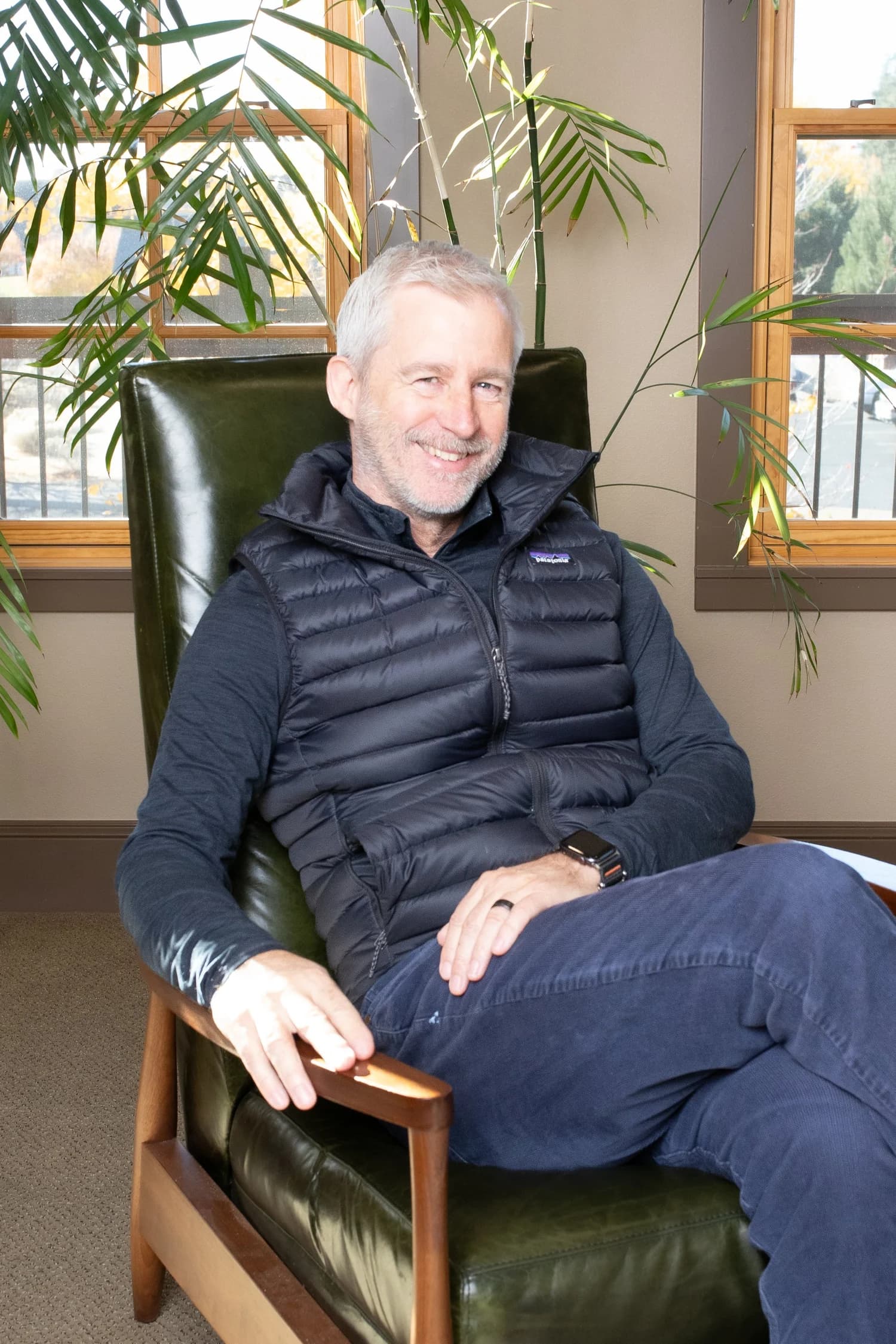
Who leads it
Tim Moore, LPC
28 years as a clinician. Trained in Internal Family Systems, somatic and transpersonal work, and ketamine-assisted psychotherapy. Roots in wilderness education and Outward Bound — the expedition frame isn't a metaphor borrowed for marketing; it's how he learned to take people into hard terrain and bring them back.
Decades of men's work: groups, intensives, the long one-on-one road. He's sat with hundreds of men who looked fine on the outside and weren't, and he's been in the terrain himself. A guide, not a chart-reader.
Licensed Professional Counselor · Central Oregon
Safety & legitimacy
Let's talk about the ketamine part.
Fair question, so here it is straight. Ketamine is an FDA-approved anesthetic that has been used off-label in psychotherapy for years, legally, under medical supervision. In this work it's administered at sub-anesthetic doses, after medical and psychological screening, with a clinician present the entire time.
What it is not: a high, a party, or a shortcut. If you're looking for an altered state for its own sake, this isn't your place. The medicine is a tool inside a therapeutic container — preparation before, guidance during, integration after.
What it also is not: a cure-all. Ketamine work has real contraindications — certain cardiac, psychiatric, and substance-use histories rule it out. That's what the screening is for, and screening out is a real outcome here. If you're not a fit, we'll say so and point you somewhere better.
Every participant is medically screened by our psychiatric prescriber before acceptance. During medicine sessions, staffing is three participants per staff member — for a full cohort of ten, that's at least three clinicians in the room. Cohorts are capped at ten men.
Licensed clinician. Medical screening. A legal framework. Real preparation and integration. That's the container — it's not negotiable.
Questions men actually ask
Straight answers.
More questions? Read the full FAQ →
Straight questions, too.
Three minutes, no clinical jargon. You'll get an honest mirror — and what to do with it.
Meet what's underneath.
Start with three minutes of honest questions. If what comes back rings true, the next step is one free call — honest on both sides. If it's not a fit, you'll know.